The Mechanics of Power and the Mechanics of Death
Charles I: The Mechanics of Sovereign Execution
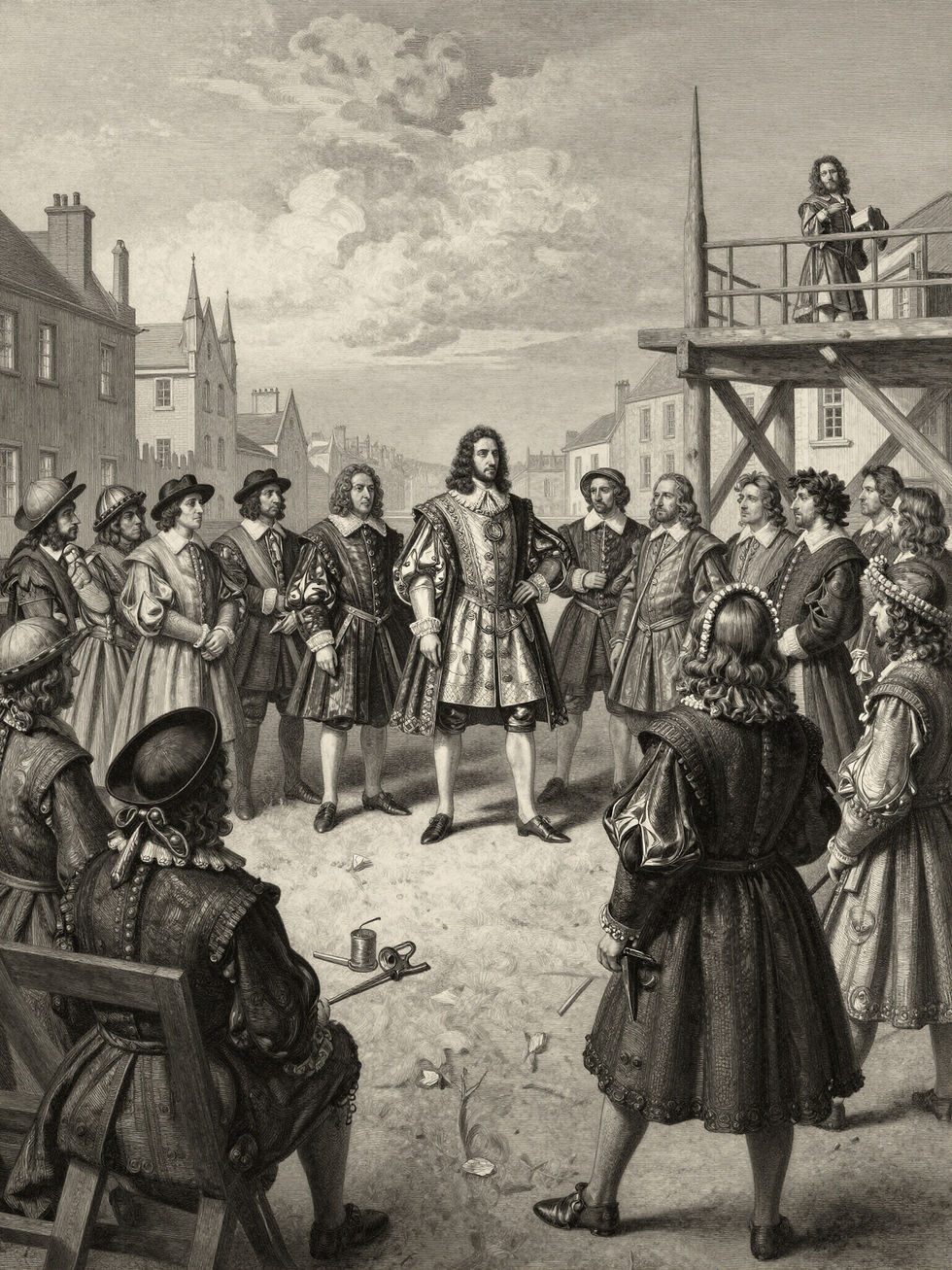
The most immediately visible difference between the two killings is procedural. Charles I died after a public, legally constituted trial. The Rump Parliament passed an act establishing a High Court of Justice, the court drew up a formal charge, the king was given multiple opportunities to enter a plea, the proceedings were recorded and printed and circulated as newsbooks across Europe, and the execution itself took place in public on a scaffold built for the purpose. Even those who held that the trial was a legal travesty had to engage with the fact that the regicide had been performed under the formal authority of an act of parliament. The killing was theatrical, deliberate, and constitutional in form.


Dessalines: The Mechanics of Revolutionary Purge
Dessalines's killing was the inverse of all of this. There was no trial, no charge, no public proceeding. The conspirators, Pétion, Gérin, and others within Dessalines's own administration, turned his escort against him on the road and shot him in an ambush. The crowd that mutilated his body afterward was acting in the absence of any legal framework; the dismemberment was an act of political symbolism, the violent erasure of an emperor, but not a punishment delivered under law. Dessalines's killers did not subsequently issue an act abolishing the Haitian empire on the grounds that emperors were burdensome and unnecessary; they simply moved into the political vacuum his death created and divided the country between them.



Immediate Outcomes
1649
1804

The political orders the two killings produced look superficially similar — in each case, the existing constitutional structure was replaced almost immediately. England moved from monarchy to Commonwealth within weeks; Haiti moved from empire to two separate states within months. But the trajectories differ in a way that matters.
The English Commonwealth that emerged in 1649 was the product of a coherent (if narrow) political coalition. The Rump Parliament passed acts abolishing the office of king and the House of Lords, declared England a Commonwealth, and proceeded to attempt, with mixed success, to govern as a republic. When Cromwell dissolved the Rump in 1653 and replaced it with the Protectorate, he did so within a recognizable constitutional sequence. Even the Restoration of Charles II in 1660 was framed as a constitutional event, conducted under acts of parliament, with the new king's authority understood to be conditional on the political settlement that had restored him. The English revolutionary experience was, in this sense, institutionally absorbed: the political vocabulary it generated remained available to subsequent English politics, and the events of 1649 became part of the constitutional history rather than its abolition.
Haiti, after October 1806, followed no comparable institutional logic. The conspirators who killed Dessalines could not agree on a successor regime or a constitutional theory under which to govern. Within months, the country had split into two: Pétion's Republic in the south, Christophe's State (later Kingdom) in the north, and would remain divided until 1820. The two halves of the country pursued radically different political projects: Pétion's Republic distributed land to small holders and developed the regional and class divisions between mulatto elites and rural Black laborers that have shaped Haitian politics ever since; Christophe's Kingdom maintained Dessalines's plantation labor system and built a militarized monarchy whose architectural monuments, the Citadelle Laferrière, the Sans-Souci palace, still stand. The killing of Dessalines did not replace one political order with another; it dissolved political order into civil war.

1649: Legislative Sovereignity Established
1804: Declaration of Black Sovereignty
3. The long arc: domestication versus punishment
The Mechanics of Domestication
The Mechanics of Punishment
Charles I (England)
Dessalines (Haiti)
The most striking difference between the two events emerges only when you look at what happened to each across the following centuries. The English Revolution was, eventually, domesticated into the British constitutional tradition. The Restoration of 1660 voided the act abolishing the office of king, but it did not erase the precedent: the Glorious Revolution of 1688, which removed James II and established parliamentary sovereignty, drew explicitly on the constitutional vocabulary developed in 1649. By the eighteenth century, English political thought treated the Civil War period as a difficult chapter rather than a foreign or unthinkable one. Charles I's execution remained controversial; it was not obscured. The cult of Charles the Martyr that began with the Eikon Basilike in 1649 continued through the Restoration and into the Anglican calendar. The Whig historiographical tradition incorporated the Civil Wars into a long story of constitutional development. By the twentieth century, the regicide had become an event teachable in any English secondary school as part of the standard national narrative.
Haiti was, by contrast, punished. France refused to recognize Haitian independence until 1825, and then only on the condition of an indemnity of 150 million francs — later reduced to 90 million — to compensate former French colonists for their lost property. The debt would consume Haiti's national budget for over a century. The United States did not recognize Haiti until 1862, partly out of deference to its own slaveholding South, partly out of a refusal to acknowledge the legitimacy of an enslaved population overthrowing its masters. Most of the slaveholding Atlantic world maintained a deliberate diplomatic silence around Haitian independence for decades. Dessalines's reputation, both in Haiti and outside it, was systematically degraded: in Haiti by the republican elite that had organized his assassination and that had no interest in commemorating him; outside Haiti by a European and American discourse that depicted him as a savage emperor and used his violence to justify the international isolation of his state. The historiographical recovery began only with the 1904 centenary of Haitian independence within Haiti itself, and only with the work of C. L. R. James, Eric Williams, and (much later) Laurent Dubois, Marlene Daut, Philippe Girard, and Julia Gaffield in English-language scholarship from the mid-twentieth century onward.

Constitutional Absorption

Systematic Isolation
The asymmetry is not an accident of historiographical preference. It tracks a fundamental asymmetry between the two revolutions themselves. The English Revolution was a struggle within the European political community over the boundaries of acceptable political action. Even after the regicide, England remained a sovereign European state, and the issues at stake in 1649 — the relationship between crown and parliament, the rights of subjects against the prerogative — were issues every other European state recognized as legitimate political questions. The Haitian Revolution was a fundamental challenge to the racial and colonial order on which Atlantic wealth and power were built. Recognizing it as a legitimate revolution would have meant recognizing that enslaved people could legitimately overthrow their masters and constitute a sovereign state. The slaveholding societies of the Atlantic world refused this recognition, and the punishment of Haiti — the indemnity, the diplomatic isolation, the discursive erasure — was the form that refusal took.
English Domestication
Political Status
Absorbed into constitutional narrative
Diplomatic Recognition
Remained within European community
Economic Impact
Internal industrial development
Haitian Punishment
Political Status
Systematically degraded reputation
Diplomatic Recognition
Total isolation until mid-19th c.
Economic Impact
Consuming debt indemnity penalty
Conclusion: what the comparison shows

Domesticated Governance
The two killings, read together, illuminate one another. Charles I's execution looks more radical when set beside Dessalines's assassination — the formal, public, constitutional character of the regicide is the genuinely novel thing about it, distinguishing it from the long European history of monarchs killed by their own factions. Dessalines's assassination looks more politically consequential when set beside Charles's — the absence of any constitutional framework for the killing, and the immediate fragmentation of the Haitian state, signals how much harder it was to consolidate a revolutionary order in a society confronting both internal class divisions and a hostile international system.
The deeper lesson is about who gets to make a revolution and have it count. Charles I's killers performed an act unprecedented in European political history and, within a generation, were absorbed into a constitutional tradition that found uses for what they had done. Dessalines's killers performed an act that was constitutionally unremarkable — an officer coup against an emperor — and were nevertheless punished, along with the entire society they belonged to, for the much more radical thing the Haitian Revolution had accomplished six years earlier: the abolition of slavery and the assertion of Black sovereignty. The asymmetry of the long aftermath is the asymmetry of the underlying revolutions, refracted through the killings of their respective leaders.

Punished Economies